Most compliance tools work at the rule level — one checkbox per section. AuditDSS decomposes every rule into its atomic obligations: the smallest units that can be independently violated, tested, and enforced. Across 320 regulations and 21 jurisdictions.
320
Regulations mapped
21
Jurisdictions
17
Regulatory categories
12,278
Rules decomposed
146,445
Atomic obligations
A single regulatory rule often contains multiple obligations, conditions, thresholds, and exceptions. Traditional tools treat each rule as one item. AuditDSS treats each testable proposition as its own node in a structured graph.
Rule-level matching
12,278 checkboxes. Binary pass/fail. No granularity.
Obligation-level mapping
146,445 testable propositions. Conditions, gates, and dependencies modelled. 11x more granular.
Ongoing customer due diligence
Original rule text: 127 words, 3 sub-sections
Reporting entity must monitor transactions for consistency with risk profile
Monitoring must be proportionate to ML/TF risk
Must update CDD when trigger events occur
Must identify and verify beneficial owners on ongoing basis
Applies only to reporting entities that provide designated services
1 rule → 5 testable obligations with typed relationships
Navigate 320 regulations, drill into individual rules, and inspect every atomic obligation. See how rules decompose and how obligations relate to each other.
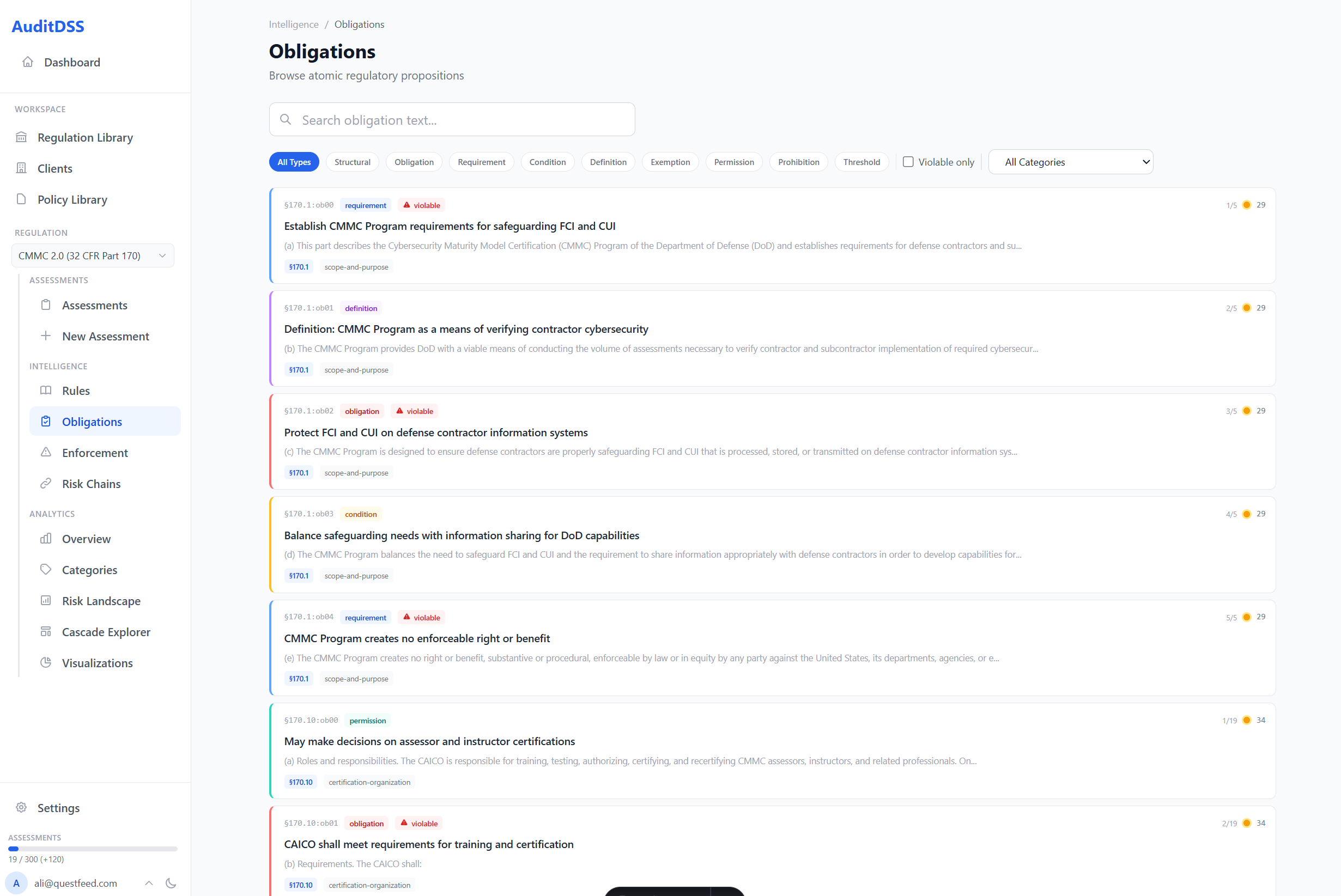
Obligations Browser
Filter by jurisdiction, category, or regulation. See obligation counts, types, and risk scores at a glance.
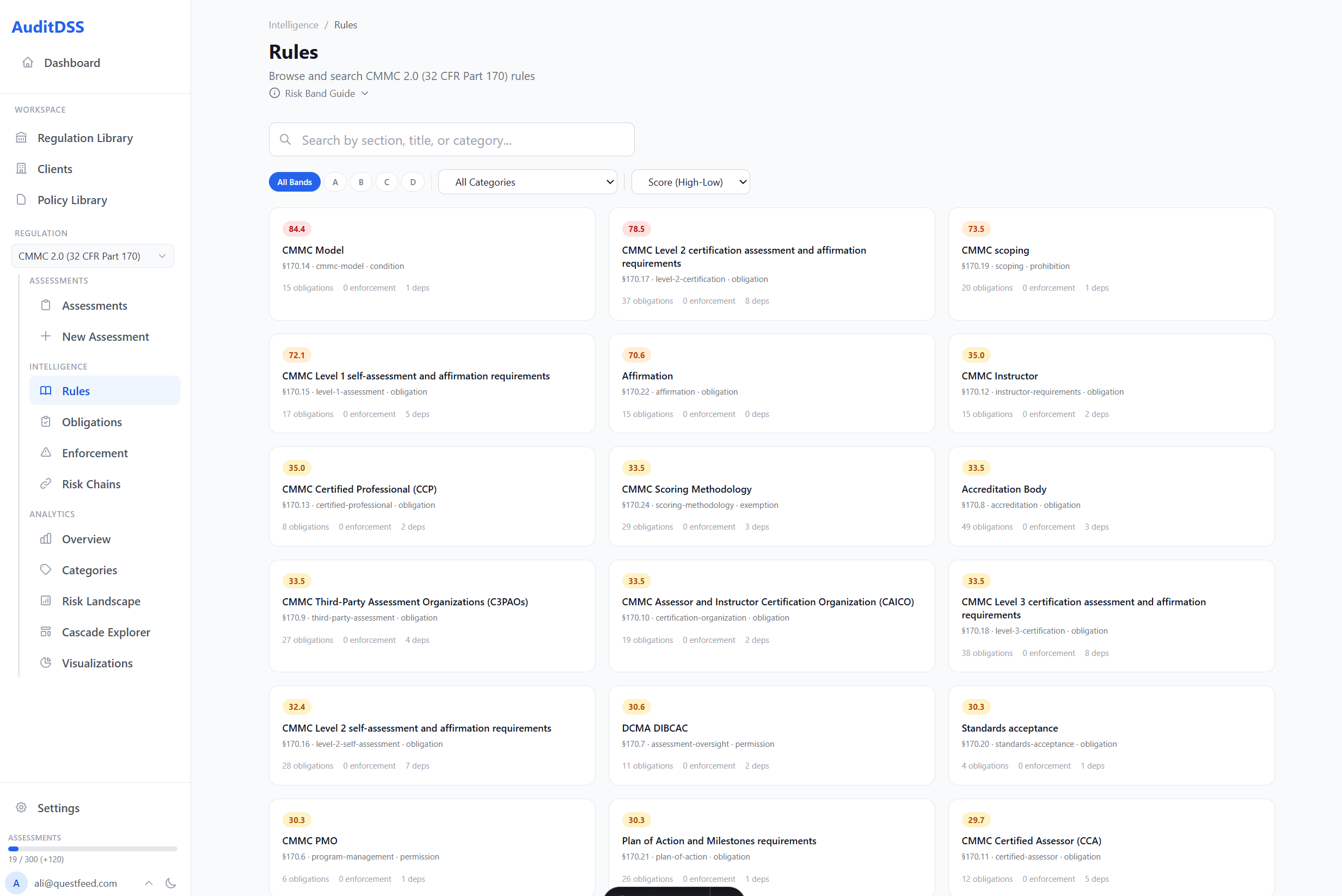
Rules Browser
Drill into any of the 12,278 rules. See the full decomposition into typed obligations with dependency edges.
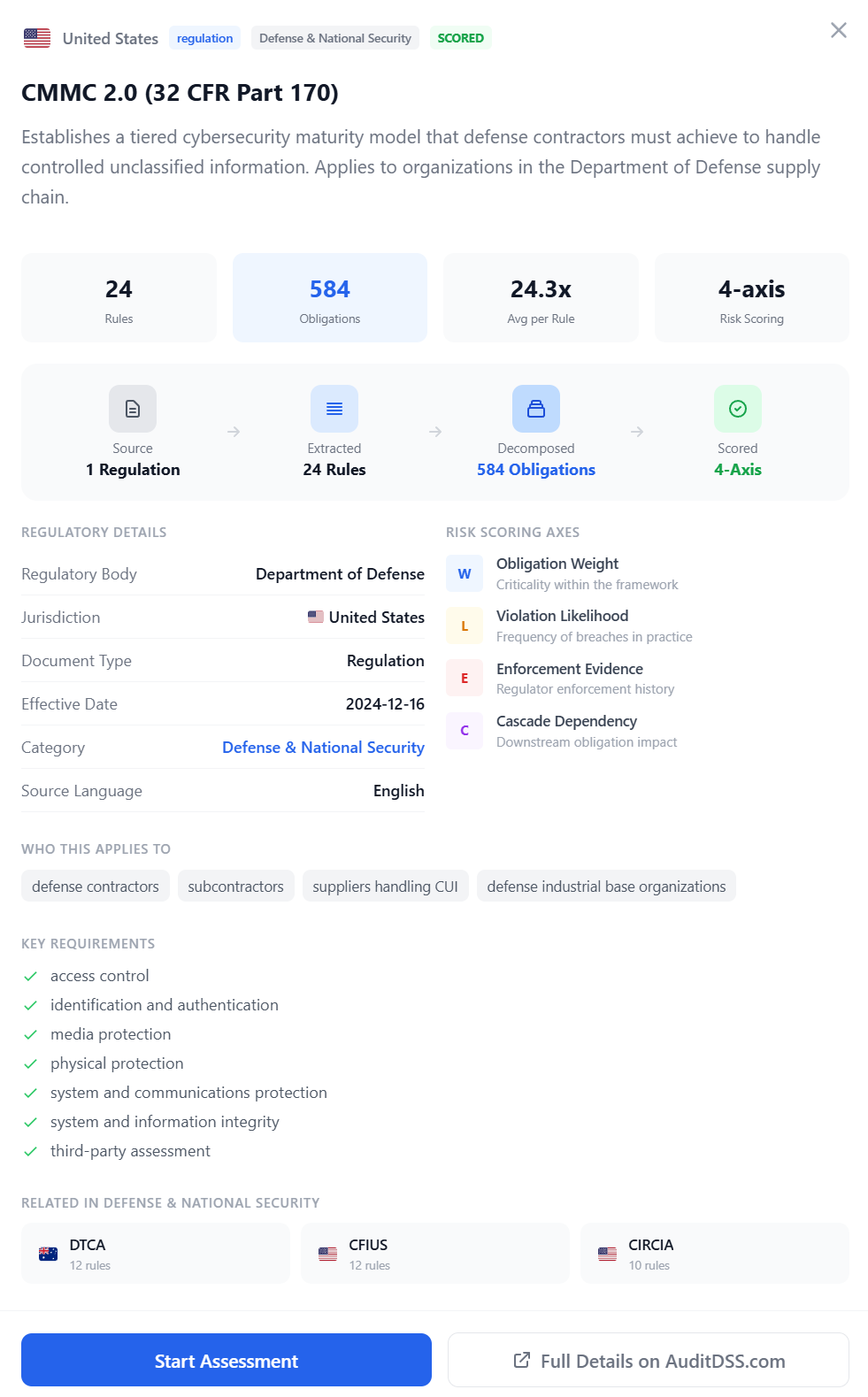
Regulation Detail Card
Each regulation card shows rules, obligations, 4-axis risk scores, enforcement history, and key requirements.
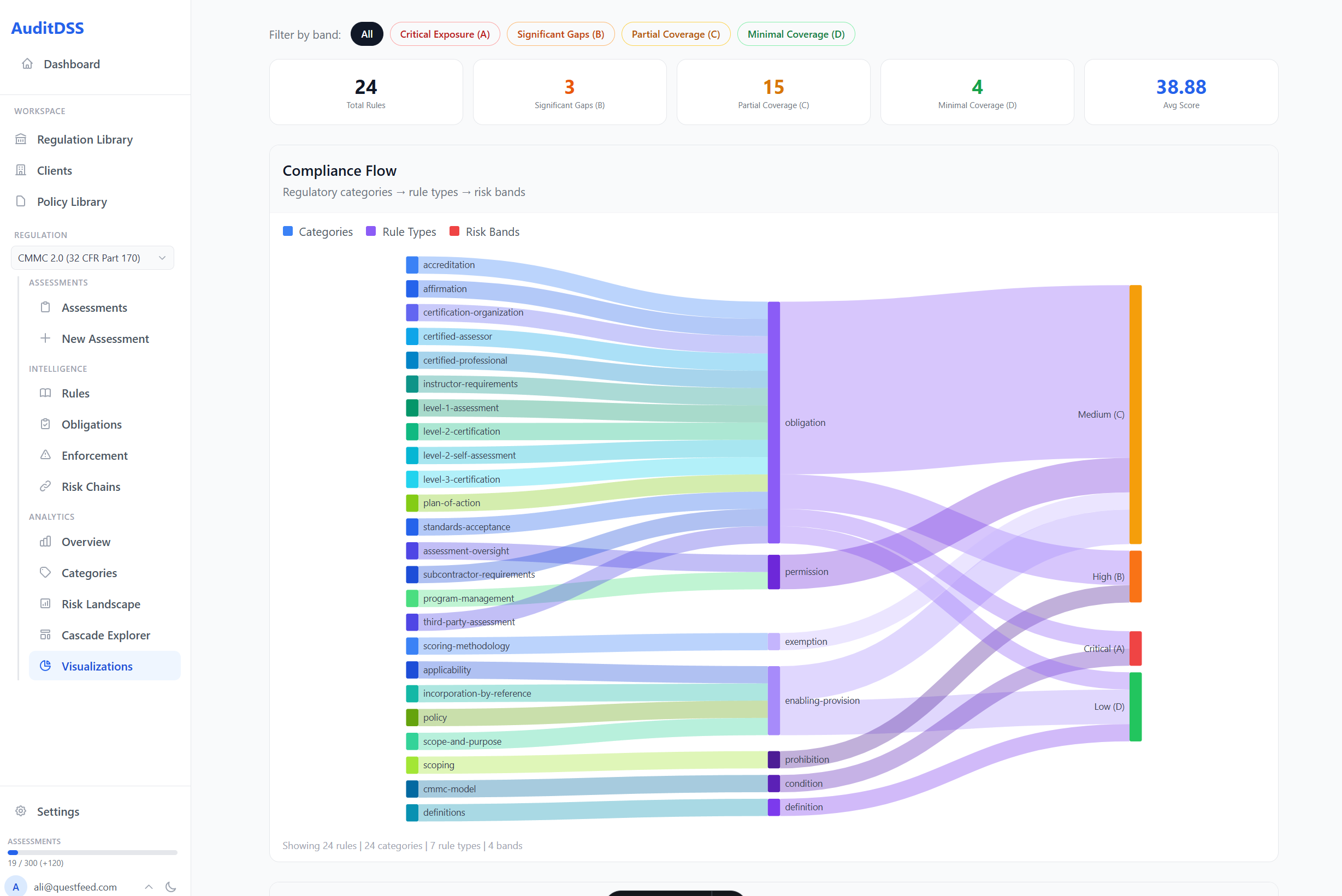
Decomposition Flow
Sankey diagram showing how regulations decompose from categories through rule types into obligation types and risk bands.
Obligations form a tree, not a flat list. Conditions attach to their parent obligations. Gates control access to entire sub-trees. Dependencies flow through the graph.
Each obligation is classified: violable (can be enforced), condition (qualifies another obligation), gate (controls applicability), definition (provides terminology), or exemption (creates carve-outs).
Cross-references between obligations are modelled as typed edges: requires, gated_by, exempted_by, defined_by. This enables cascade analysis — a gap in one obligation propagates risk to all dependents.
Browse 320 regulations across 21 jurisdictions. See exactly how each rule decomposes into testable obligations, with typed relationships and dependency graphs.