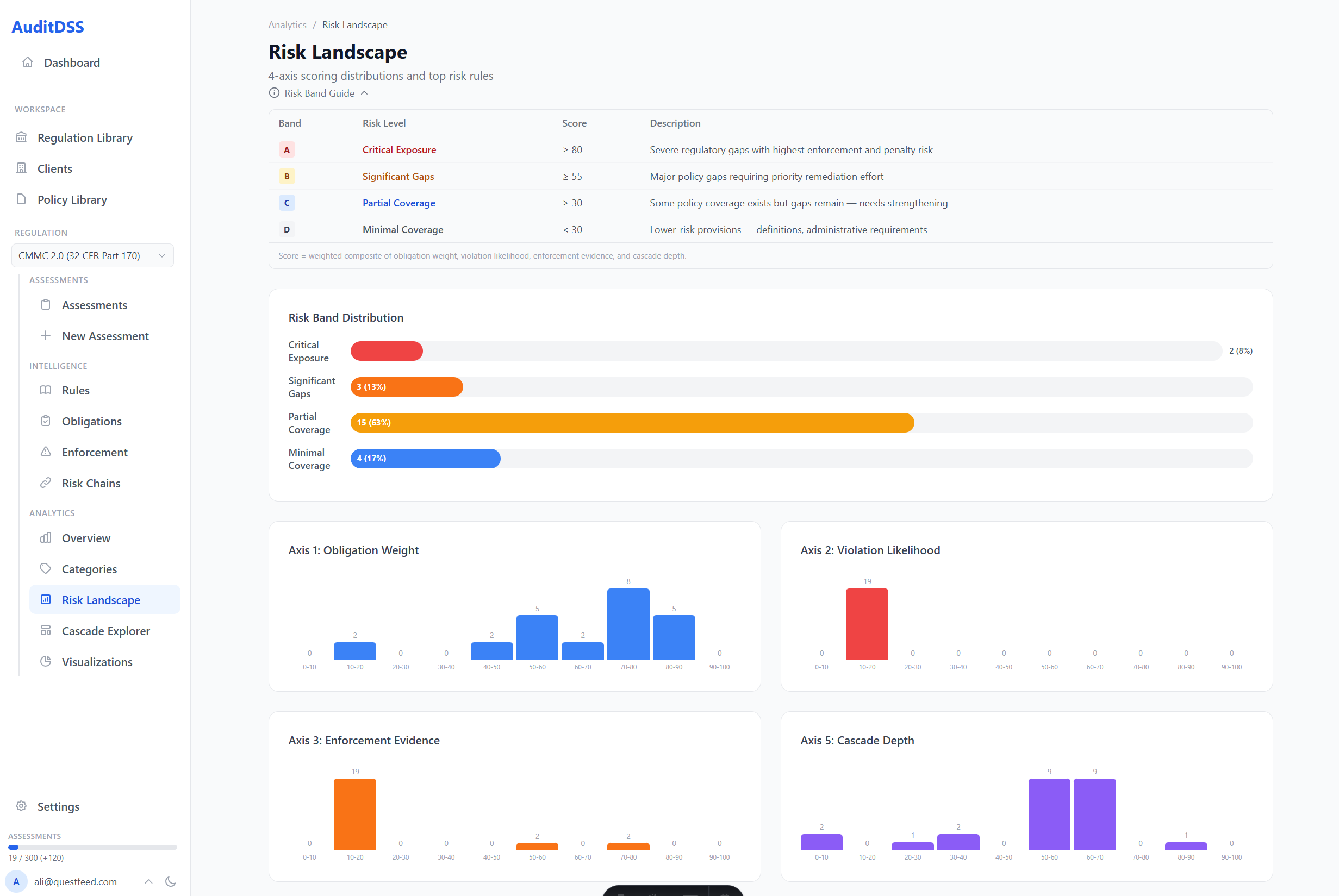
Risk Landscape — distribution of all four scoring axes across obligations
Not all compliance gaps are equal. A missing customer identification procedure carries vastly more risk than a missing record-keeping timestamp. AuditDSS scores every gap across four risk dimensions so you know exactly where to focus.
Risk Landscape — distribution of all four scoring axes across obligations
Each axis captures a different aspect of regulatory risk. Together, they produce a composite score that reflects the true priority of each gap.
Axis 1 — Structural importance
How critical is this obligation within the regulatory framework? Measured by structural position in the obligation graph, number of dependent obligations, and regulatory category significance.
Axis 2 — How often is this breached?
Probabilistic estimate of how likely this obligation is to be violated, derived from enforcement patterns, category-level breach rates, and structural complexity of the obligation.
Axis 3 — Real regulatory action
Has the regulator actually enforced this obligation? How frequently? What penalties resulted? Calibrated against real enforcement actions, penalty amounts, and international assessments across 21 jurisdictions.
Axis 4 — Blast radius
How many other obligations depend on this one? If this obligation fails, how far does the failure cascade through the regulatory graph? Measured using Bayesian propagation through the dependency network.
One gap cascades to 15 dependent obligations
The four axes combine into a single composite risk score per gap. This gives you a clear, defensible priority order — fix the gaps with the highest composite scores first.
Risk scores surface everywhere — from the executive summary to the detailed priority stack.
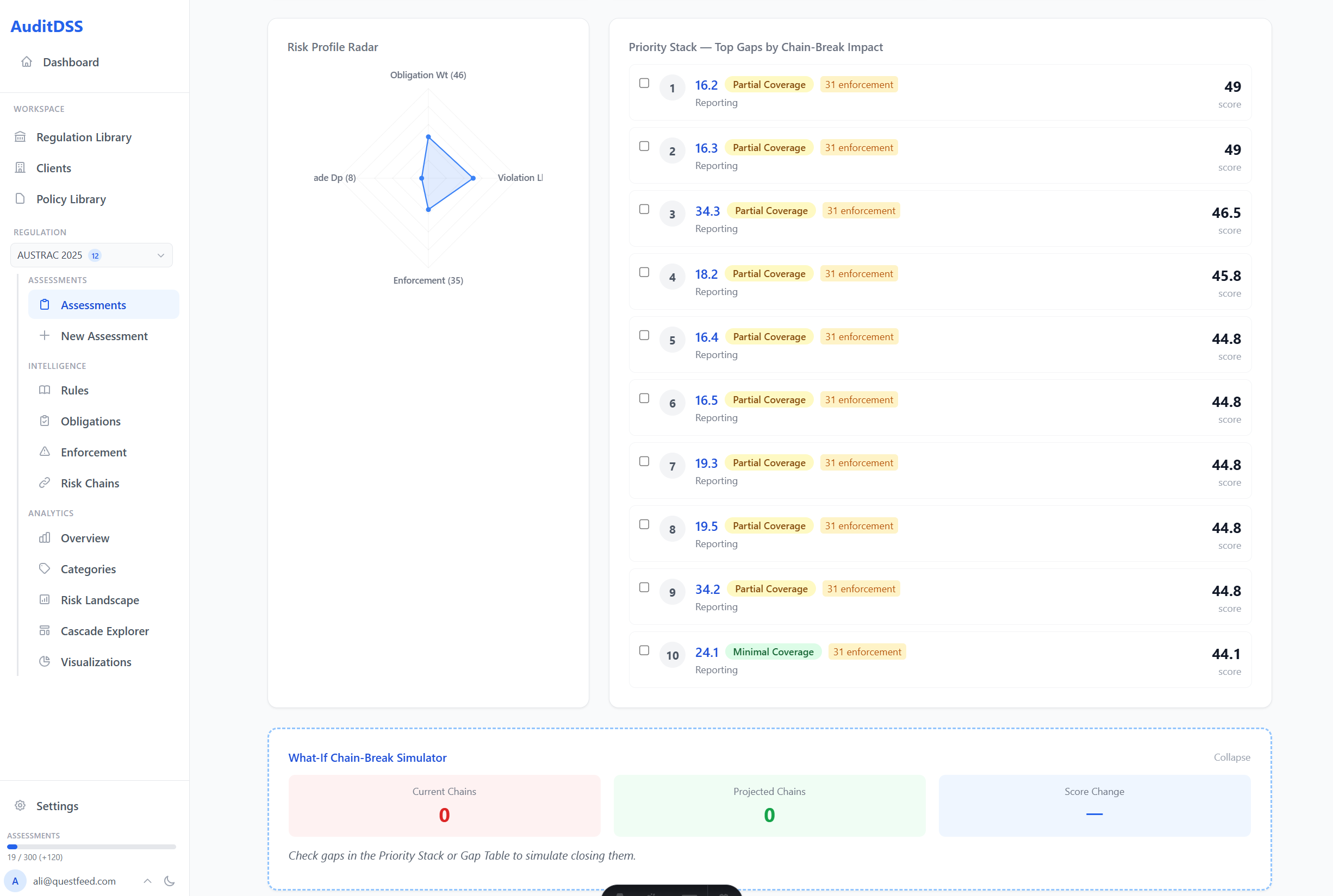
Risk Radar and Priority Stack
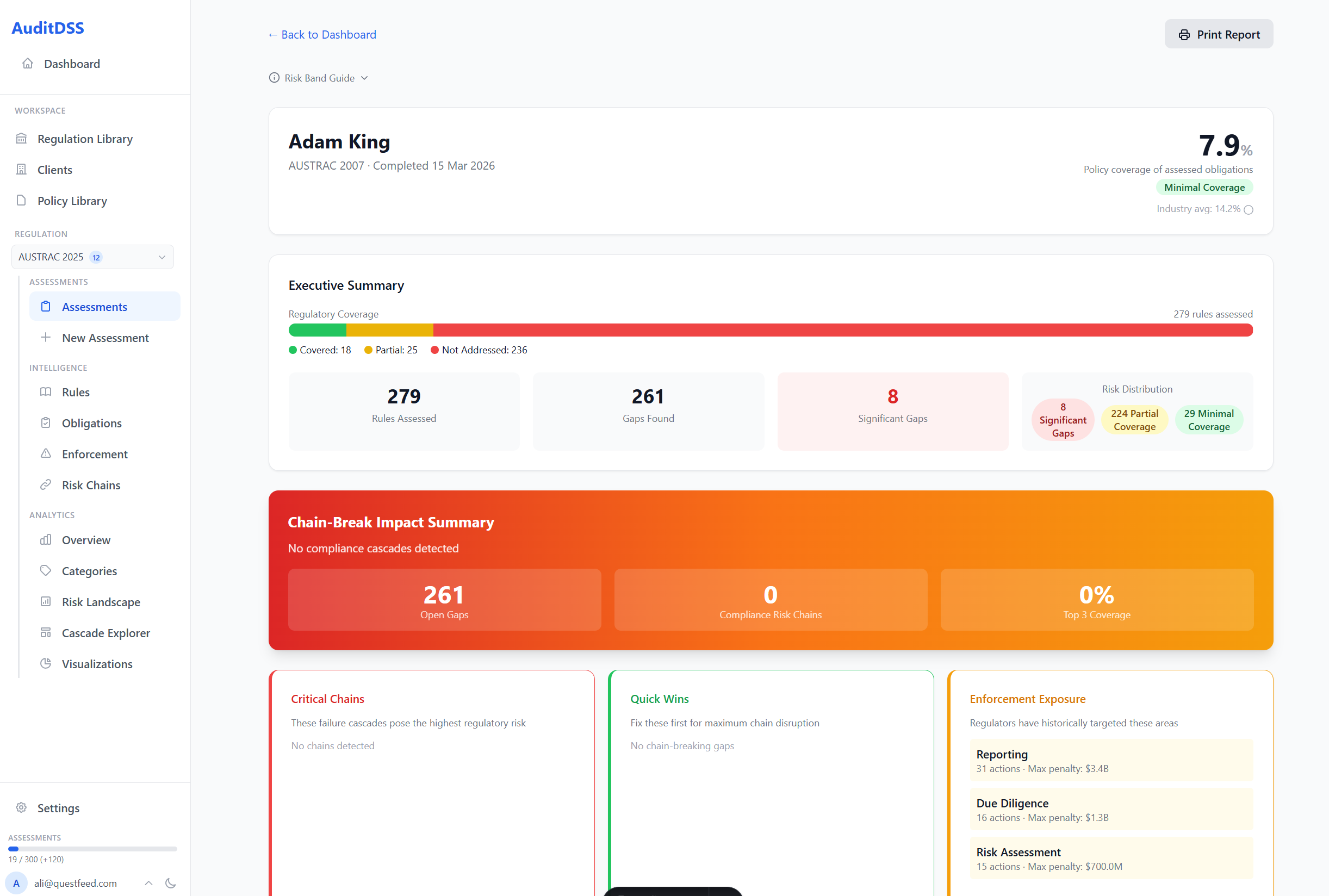
Executive Summary with composite scores
Stop treating all compliance gaps as equal. Get a risk-scored priority list based on real enforcement data.